

Be yourself; Everyone else is already taken.
— Oscar Wilde.
This is the first post on my new blog. I’m just getting this new blog going, so stay tuned for more. Subscribe below to get notified when I post new updates.
The news comes fast and furious these days. Two items from the week before this one really caught my attention and happen to be related. The first was Bill Gates’ announcement that “climate change” wasn’t going to kill us and some funds targeted for its mitigation might be spent on more pressing problems (1). Of course, he’s caught some flack

My wife figures ol’ Bill saw the money for climate change drying up with this new administration and is in search of his next money-making save-the-world venture.
News of adherents bailing may be slow in coming, as so many have embraced climate change as a secular religion (2,3,4). There are still a lot of Lieutenant Onodas out there (5), especially in academia, the source of the 2nd news item.

Lt. Hiroo Onoda followed his elite intelligence unit into Lubang, a tiny island in the Phillipines, in December 1944. Within weeks of his arrival, a US attack forced Japanese combatants into the jungle – but unlike most of his comrades, Onoda remained hidden on the island for nearly 30 years. He was discovered, still battle ready, and refused to surrender until they brought in his commanding officer to tell him the war was over.
If you don’t read the University Record, you missed this (6). Teams from the 2 UofMs (Michigan, Minnesota), led by Michigan’s Prof Goldstein, compiled greenhouse gas data in all 3531 cities in the contiguous USA (7). Rather than measurements, gas volumes were derived from amount of pork, beef, and chicken consumed in each locale, determining supply chains for the meat consumed and from these data, generated a map of the “mat generated” greenhouse gasses. Their paper appeared in one of the Nature journals, considered by many in academia as the most prestigious science journals. Perhaps Nature has different standards, but this so-called” scientific” paper doesn’t even have a methods section! Instead, there’s a whiny introduction citing other more accurate methods they could have used if only they weren’t so costly, labor intensive, or held by private companies they’d have to pay to use. They did generate some nice maps, like these which show levels of meat generated greenhouse gases pretty much following population density.

Fig. 1 | Meat consumption and carbon hoofprint across the USA. a, Per capita meat consumption (beef, chicken and pork) (kg percapita) (top) and hoofprint (kgCO2e per capita) (bottom) for 3,531 US cities. b, Comparison of per capita meat consumption (left) andhoofprint (right) for California (top), the Northeast (middle) and Texas (bottom). Consumption values are before retail and consumerlosses (for example, kilograms delivered to retail). Based on uncertainty analysis, there is a mean absolute percentage error of 26%from baseline across all cities (Supplementary Fig. 1).
But eating meat is like driving an EV: the greenhouse gasses propelling the activity are generated far from the activity itself. The authors propose a couple ways to mitigate this horrible scenario: reducing food waste and substituting other protein sources for beef. At least they didn’t cite the European model of killing as many cows as possible. Indeed, their model implies it’s the eaters’ fault, not the cows’. Might the map provide the EPA enforcement force with targets as they set about offing the eaters? Given how Mr. Gates relishes reducing the population, perhaps he’ll be participating. Surely the Lt. Onodo’s in today’s Climate Commandos won’t be taking this lying down. They can track methane from space now (8)! Pray they don’t weaponize the agent transmitted by the Lone Star tick that causes “alpha-gal syndrome”, in which victims develop an intense allergy to red meat (9). Just like a “vaccination”! Could we coax Dr. Fauci out of retirement?Hard to say when this anti-meat crusade began. The 2018 UN encyclical on climate change mentioned that we need to focus on some of the agricultural sources of greenhouse gasses (10). With those ruminants producing methane as a byproduct of digesting vegetation we cannot, turning it into protein and milk we can. With apologies for every sniggering adolescent out there, please know that most of the methane comes from eructation, not flatulence (11).
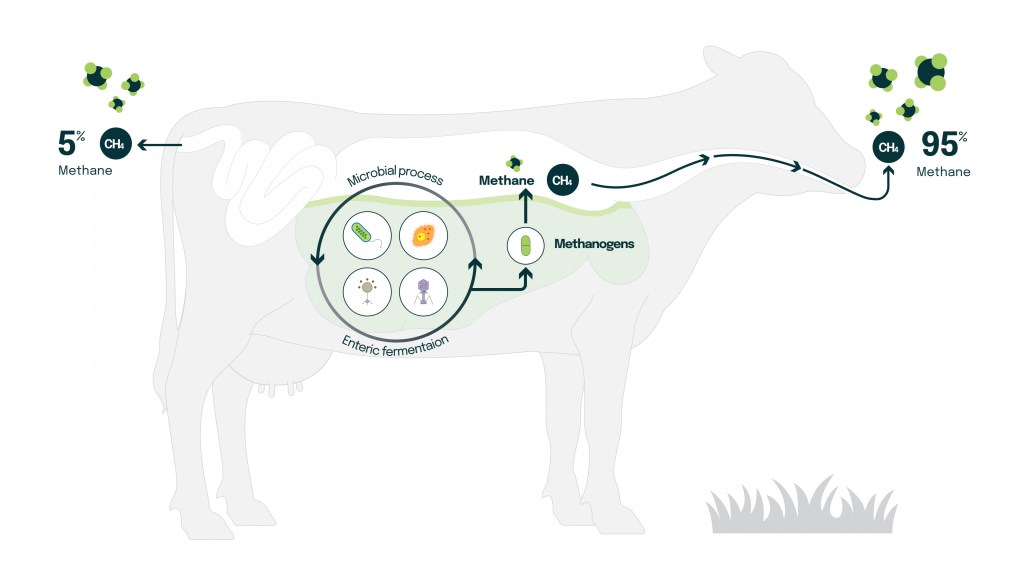
Indeed, an entire industry has grown up to address the “problem”, from sophisticated monitoring to mask traps to measure to modify to the cow’s microbiome to be less gassy (12). The frenzied self-righteousness that arose predated any actual changes in eating behavior, but we were made to feel guilty when we bit into a juicy steak rather than bugs, lab grown meat (“cellular agriculture”) or a full conversion to veganism. Those Petrie dish patties were lauded as almost o.k., any loss of taste from the real thing more than made up for by the good feeling to be had by knowing how such eating behavior was doing for the environment. It all came together to transform one of man’s most beloved and helpful domesticated animal into some kind of villain.

While there wasn’t a little boy standing to comment on the emperor’s attire, Investigators from Virginia Tech published in early 2021 that sudden disappearance of all dairy cattle from the US would reduce greenhouse gas emissions by a whopping 0.7% (13). Not to mention all the nutrients that would no longer be provided to a hungry population. The EPA estimates that all greenhouse gasses from meat and dairy production account for just 4% of domestic emissions (14). If every man, woman, and child in America turned vegan tomorrow, estimates suggest the US would produce just 3% fewer emissions (15).
But wouldn’t less meat be a benefit not only to the planet, but to the eaters? I’ve been hearing about the horrors of red meat since medical school (I graduated ’79). Often touched with a “meat is murder” layer of guilt, cutting into that steak could be a political statement. In late 2019, a metanalysis was published in Annals of Internal Medicine (one of the premier journals in my field) evaluating claims that red meat consumption results in increased risk of heart disease and cancer. From 61 studies involving 4 million participants examining these associations, they concluded “certainty of evidence for these risk reductions was very low” (16). But if we still crave meat, we can now get it from the lab, avoiding all that messy animal stuff (17).
Our ancestors began herding cattle 8,000-10,000 years ago in the Fertile Crescent and Africa, just slightly after civilization began so man could brew beer. Cows depositing their waste material and walking all over it make for fertile ground that can be cultivated to grow other foods. As our bovine friends fight for their lives, some of their human proponents have pointed out that the fields in which cows graze make excellent carbon sinks, (18) and that methane can be used a fuel (19), even powering tractors (20)!
Yet, the global warming (sorry, climate change) fanatics continue to push for eradication of cattle. Most of that force has been applied in Europe, but quietly in the US the size of our beef herds is decreasing, and beef prices are skyrocketing. I don’t think this was part of the Green New Deal, but how long are those bills congress passes these days, so who knows what might be in ‘em!? The EPA and USDA continue their war on ranchers, using things like obscure water rights regulations and emissions reporting requirements. Their plight may be improving, as the Supreme Court has decided in their favor, ruling they cannot use regulation on water rights to regulate discharges (21). Perhaps under pressure from Trump’s EPA administrator Lee Zeldin, the agency is refashioning itself as a champion for hungry broke Americans by announcing how rollbacks of some of its regulation will be a boon (22).
The Woke EU bureaucrats have heaped so many regulations and policies on their charges, it’s hard to know where to holler “uncle” first. Every now and then the tractors and manure spreaders in the streets and flinging of animal feces at government buildings become so unavoidable, they leak into our mainstream media. The Netherlands was the first eruption, as the government plans to reduce emissions by halving the country’s number of livestock (23). Farmers took to the streets in their big vehicles, and the Netherlands now has a center-right government. I think the cows are still happily chewing away at their share of that green little county. But protests were continent-wide: Germany, France, U.K., Poland, Spain, Austria, Belgium, Italy, Greece, the Czech Republic (24). Not all beefs – as it were – were about cattle, with issues on imports, fuel subsidies, and unfair competition getting attention. The pressure has brought around real change, like the EU deciding to exclude cattle farming from regulations on livestock emissions (25). Always available to governments is the brute theft of taxation, and the Danes see that as their way forward to a cooler future (26).
The war on Elsie looks like its winding down, but with so many true believers left in positions of authority, you can never be too sure. What can one person do? I believe a meme I saw a few days ago pretty well sums it up
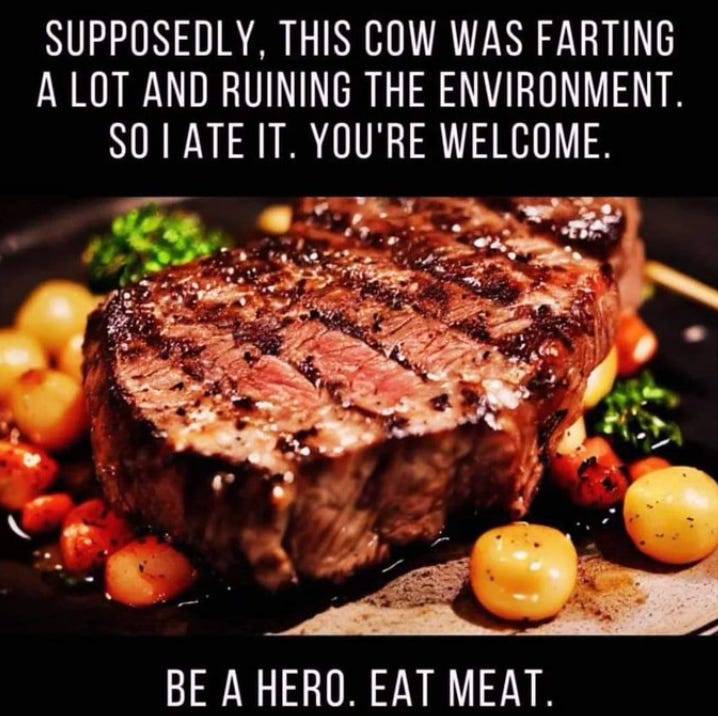
Bon appètit!
References
1. Gates B. Three tough truths about climate. Gates Notes 10/27/25. https://www.gatesnotes.com/home/home-page-topic/reader/three-tough-truths-about-climate
2. mfbukowski. Climate Change as Secular Religion. Mormon dialog and discussions board. 1/24/18. https://www.mormondialogue.org/topic/70111-climate-change-as-a-secular-religion/
3. Kuehn EF. Is the Climate Crisis a Secular Eschatology? University of Chicago Divinity School 10/3/19. https://divinity.uchicago.edu/sightings/articles/climate-crisis-secular-eschatology
4. Baker G. St. Greta Spreads the Climate Gospel. Wall St Jl 9/20/19. https://www.wsj.com/articles/saint-greta-spreads-the-climate-gospel-11568989306
5. Balmont J. Onoda: The man who hid in the jungle for 30 years. BBC 4/13/22. https://www.bbc.com/culture/article/20220413-onoda-the-man-who-hid-in-the-jungle-for-30-years
6. Davenport M. Revealing the ‘carbon hoofprint’ of meat consumption for American cities. Michigan News 10/20/25. https://news.umich.edu/revealing-the-carbon-hoofprint-of-meat-consumption-for-american-cities/
7. Goldstein BP, Pelton REO., Gounaridis D. et al. The carbon hoofprint of cities is shaped by geography and production in the livestock supply chain. Nature Clim Chan (2025). https://doi.org/10.1038/s41558-025-02450-7s
8. New NASA Instrument Catches Super Methane Emitters Red-Handed. The Weather Channel 10/27/22. file:///Users/bobscomputer/Desktop/cow%20farts/New%20NASA%20Instrument%20Catches%20Super%20Methane%20Emitters%20Red-Handed%20-%20Videos%20from%20The%20Weather%20Channel.html
9. The Mayo Clinic Staff. Alpha-gal syndrome. Mayo Clinic 8/8/25. https://www.mayoclinic.org/diseases-conditions/alpha-gal-syndrome/symptoms-causes/syc-20428608
10. De Coninck H et al. Strengthening and Implementing the Global Response in Global Warming of 1.50 C, Intergovernmental Panel on Climate Change (IPCC) report, 2018, https://ipcc.ch/site/assets/uploads/sites/2/2019/02/SR15_Chapter4_Low_Res.pdf
11. Holmes B. Cleaning up cow burps to combat global warming. Knowable Magazine 6/10/24. https://knowablemagazine.org/content/article/food-environment/2024/reducing-methane-emissions-from-livestock
12. How Dairy Farmers Are Reducing Methane And Greenhouse Gas Emissions. Undeniably Dairy 2/2/22. https://www.usdairy.com/news-articles/farmers-reducing-methane-gas-from-cows?gclsrc=aw.ds&campaignid=21324250699&adgroupid=168030205092&keyword=cows%20burp%20methane&device=c&gad_source=1&gad_campaignid=21324250699&gbraid=0AAAAAC58wDew5xr8t9hMKxYk2mdaHn-MI
13. Esterhuizen M. Virginia Tech Researchers Find that Removal of Dairy Cows Would Have Minimal Impact of Greenhouse Emissions. Virginia Tech 1/6/21. https://vtnews.vt.edu/articles/2020/12/cals-white=research.html
14. Environmental Protection Agency. Inventory of U.S.Greenhouse Gas emissions and Sinks: 1990-2017, April 2019, https://www.epa.gov/sites/produ ction/iles/2019-04/document/us-ghg-inventory-209-chapeter-executuve-summary.pdf
15. USDA/Agricultural Research Service. Exploring a World without Food Animal. Science Dailu 6/18/2021, www.sciencedaily.com/rleSES/2017/12/12/17120622218.HTML
16. Johnston BC, Zeraatkar D, Han MA, Vernooij RWM, Valli C, El Dib R, Marshall C, Stover PJ, Fairweather-Taitt S, Wójcik G, Bhatia F, de Souza R, Brotons C, Meerpohl JJ, Patel CJ, Djulbegovic B, Alonso-Coello P, Bala MM, Guyatt GH. Unprocessed Red Meat and Processed Meat Consumption: Dietary Guideline Recommendations From the Nutritional Recommendations (NutriRECS) Consortium. Ann Intern Med. 2019 Nov 19;171(10):756-764. https://annals.org/aim/articlr/doi/10.7326/M19-16
17. DutkiewiczJ and Rosenberg GN. The Sadism of Eating Real Meat over Lab Meat. New Republic 2/23/21. https://newrepublic.com/article/161452/sadism-eating-real-meat-lab-meat
18. Reed B. Cows help farms capture more carbon in soil, study shows. Guardian 9/28/24. https://www.theguardian.com/environment/2024/sep/28/cows-help-farms-capture-more-carbon-in-soil-study-shows
19. Melnick P. Dairy Farm Sustainability: Turning Methane into Energy. New England Dairy 4/23/25. https://www.newenglanddairy.com/blog-post/cows-greenhouse-gas-emissions/
20. Blain L. Dung-powered tractor drives down agricultural emissions. New Atlas 1/16/23. https://newatlas.com/energy/cow-dung-tractor-biomethane/
21. Wolfson L. Supreme Court Ruling For Western Ranchers Over EPA Is A Win For Private Property Rights. Harriett Hagem Wyoming’s Congresswoman 5/25/23. https://hageman.house.gov/media/in-the-news/supreme-court-ruling-western-ranchers-over-epa-win-private-property-rights
22. EPA Press Office. EPA Announces Action to Support Lower Food Prices for Americans and Reduce Burden on American Farmers by Addressing Meat and Poultry Discharge Regulations. EPA 8/30/25. https://www.epa.gov/newsreleases/epa-announces-action-support-lower-food-prices-americans-and-reduce-burden-american
23. Ro C. The Netherlands, A Country Of Livestock, Grapples With Eating Animals. Forbes4/29/24. https://www.forbes.com/sites/christinero/2024/04/27/the-netherlands-a-country-of-livestock-grapples-with-eating-animals/
24. Salmonsen D. Why are EU farmers protesting? FB 2/28/24. https://www.fb.org/focus-on-agriculture/why-are-eu-farmers-protesting
25. Igina M. Emission-Intensive Cattle Farming Excluded From New EU Rules for Livestock Pollution. EARTH.ORG 3/13/24. https://earth.org/emission-intensive-cattle-farming-excluded-from-new-eu-rules-for-livestock-pollution/
26. Euronews. Danish livestock farmers to be taxed for cow and pig-made greenhouse gases. Euronews.com 6/26/24. https://www.euronews.com/my-europe/2024/06/26/denmark-cow-and-pig-burp-tax-to-be-rolled-out-in-2025
My dear Catholic friend Angie reminded me this morning that in her Church, today is All Souls’ Day, conclusion of the spiritual triumvirate they’ve made out of this cross-quarter day (halfway between autumn equinox and winter solstice) Samhain: All Hallows Eve (which we heathens know as Halloween), All Saints’ Day, and All Souls Day. The first is a vigil for All Saints’ Day, where the saints are remembered and honored, then today is for the souls of the departed. The vigil is to pray for those dear to us now gone, and they will pray for us. To show her how close we hold our dear departed, I took a picture of our “family wall” where we’ve been hanging pictures of our predecessors over the past several years.

While my pic gives an appreciation for the scope of the project, details of individual pictures are missing. Angie’s Android doesn’t take some things from my iPhone, like Powerpoint files, like I tried to send her about an upcoming lecture. So I thought I’d cover a couple bases by posting the annotated pics on my blog, keeping me in touch with memories of the pictured persons.
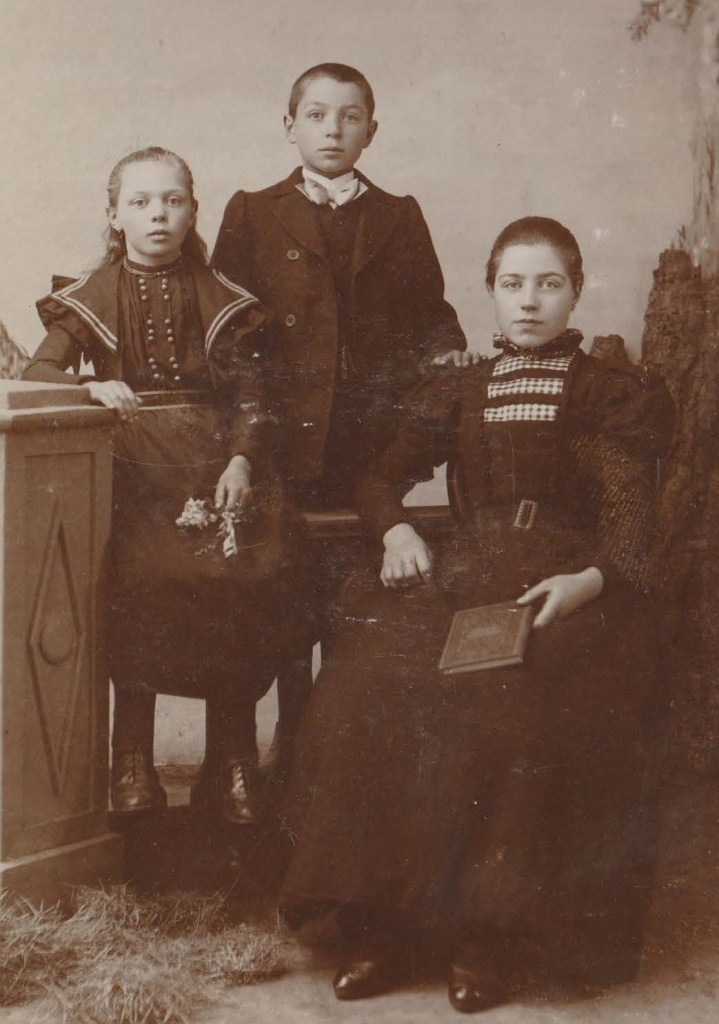
Here’s my Grandpa Ike with his 2 sisters back in Holland in the 1880s
Here’s my Grandpa and Grandma Slater with my mother, Marion, early 1920s. Grandpa’s fierce visage mellowed with time to yield the smiling friendly face everybody loved.

Here’s those Slater kids in the mid-30s. Baby James, Marion (Mom), and Doris (Aunt Dorie)

Kathy’s grandparents: Harald and Gladys Olsen, ~1928, possibly their wedding.

Kathy’s mom Ruth with her bestie, Rex.
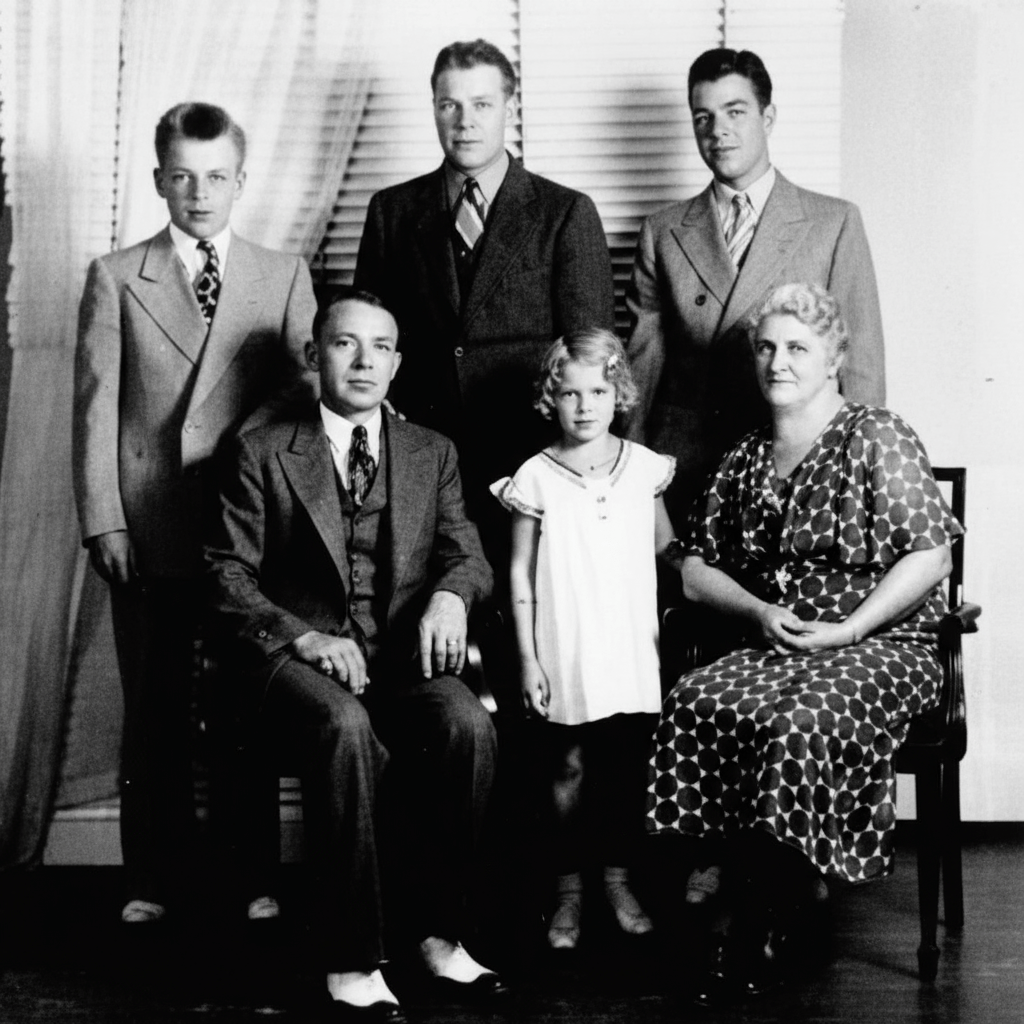
The Ike family ~ 1930. Dad (Dickie), Bob (born Bowenus, nicknamed Bub), Gary (born Gerritt). Then Grandpa (Dirk), little Florence, Grandma (Dena)

Slater Family mid 30s. Grandpa (Bill), Mom (Marion), Grandma (Vera), Aunt Dorie (Doris), Uncle Jim

Mom and Dad in their youth, before World War II and Little Bobby came along

These are my biologic parents. Marlene Gilbert and Dick Spei had a fling based mainly in the Thumb in ’51-2. I got to know them both starting in 2009.

Here are the Clarks in all their glory, late50s. Major, Clutch, Ruth, Kitty (later Howard Cosell), Bob, Ric, Kathy. Only Bob and Kathy are still with us.
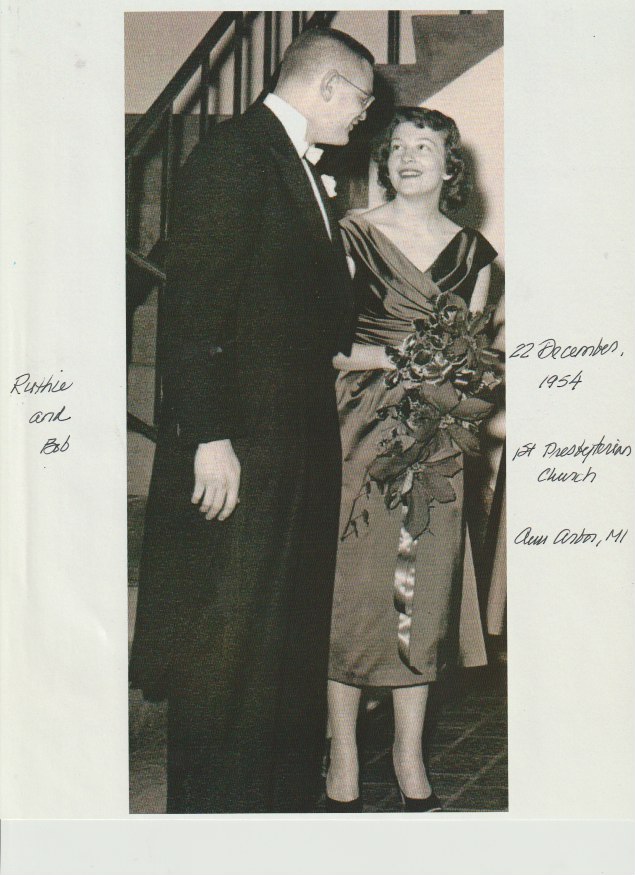
Clutch and Ruth headed to some Christmas gala in Akron. As the new orthopedist in town, Clutch was in demand socially. The edges are clipped off in the wall pic, but I left them on here.

The Ikes relax at Glen Lake, 1947. Mom (Marion), Grandpa, Grandma, Dad.
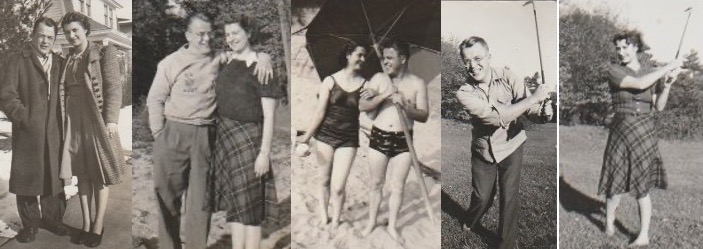
Mom and Dad at play after the war, before Bobby. They were both pretty good athletes and a force on the golf course.

Clutch and Ruthie graduate 1954. An MD for Clutch and a BA in dental hygiene for Ruth.

Dr. Robert Clark of Pittsburgh hosts his grandsons Bob and Ric, 1962

Grandpa Ike standing astride his kingdom at Bissell, where he was an ace machinist.

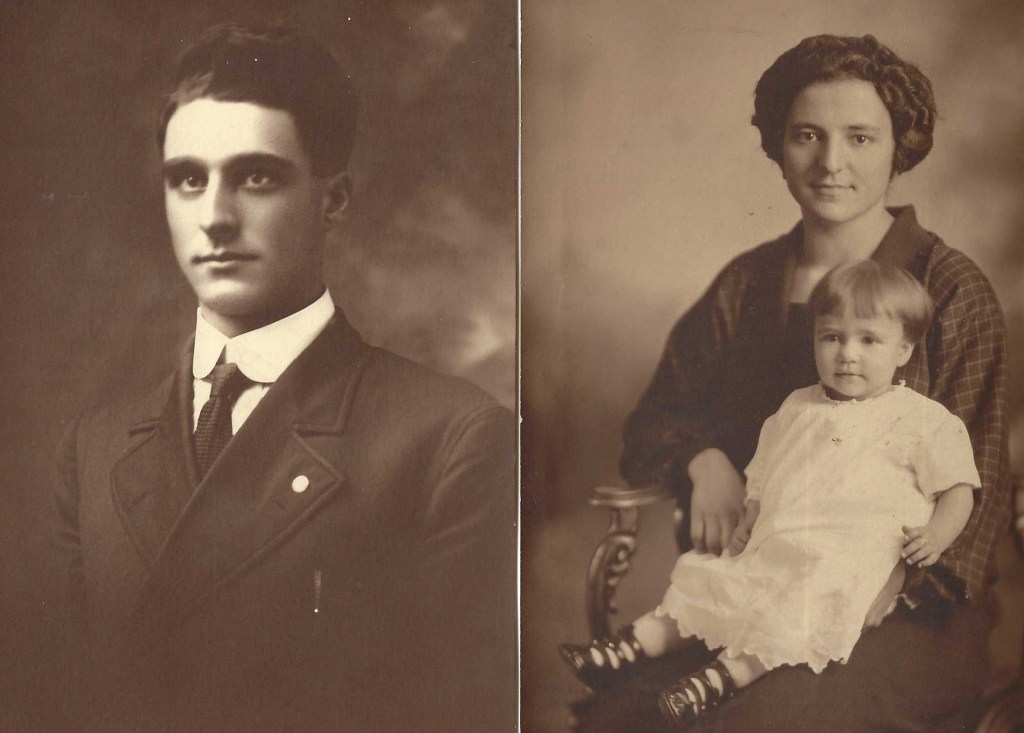
Grandpa Slater shortly after signing on to the Grand Rapids fire department in February 1929. That’s him to the left, the dark-haired handsome man with a bow tie. This was the pic that inspired the whole project. This is a scan of one of my paper copies and doesn’t show the whole oval picture.

An iconic Clark family picture: Jimmy (Mertz) all ready for something.

Very much alive, here’s the Clarks after dinner at Costanoa, a resort south of Jim’s home in Pescadaro. Left to right: Orion, Mertz (Jim), Skyler (behind the phone), me, Janet (mom), Kathy, Aislynn. So, that’s the Family Wall. Once I post this, there won’t be too many hours left in All Souls day. I hope my friend Angie realizes each struggle with a file to post can be a little prayer, as I’m thinking of them all the while. I know from my charmed life that they are praying back all the time. If you’ve got family photos languishing in a storage box somewhere, get them out! We owe so much to those who came before; it’s not only right that we remember and acknowledge them, and it’s good for the soul..
Recall Mr. Prine in this topic.https://www.youtube.com/watch?v=nXbEFTv9zr0&list=RDnXbEFTv9zr0&start_radio=1.
Timing is everything. At my first stab at this blog, I thought I had the greatest lead-in: “Should an older man on the eve of his 39th wedding anniversary be spending time waxing over his mancave?” There’s no relation between the two dates, only that some improvements in my mancave have finally settled in. Our anniversary and that football game have come and gone, and more than ever I want to share my updates. I announced the mancave a month or so ago (1), and every moment down there has been bliss. But that doesn’t mean I don’t keep my eye open for possible improvements. And some did come my way. I feel compelled to describe them here.
For starters, let’s see a shot from my new toy. My collected cell phone camera lenses include a “fish eye’. This gives you a panoramic view of the business side of things, and hints at other additions. You can see that next to the big Cody painting is a smaller framed item. That’s the photo taken at Bull Run Tavern in Shirley, Massachusetts (45 miles west of Boston) that inspired Angie’s painting; you can see it in my earlier post. You can see the dryer face is plastered. Here’s what you’re seeing.

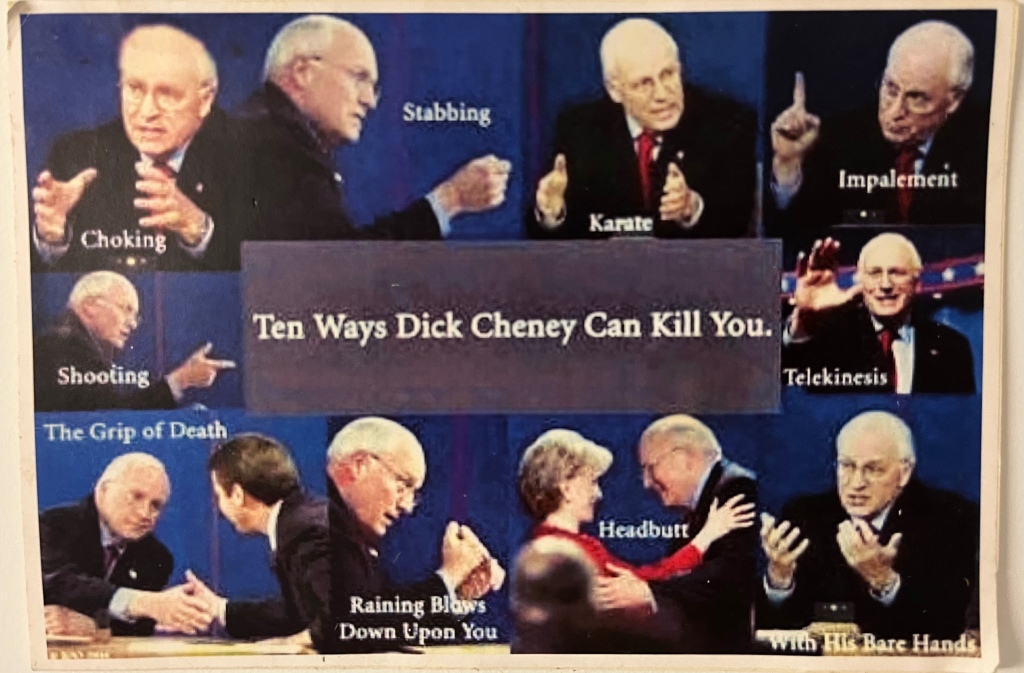
That lintel over the washer and dryer had been bare. Now see it ordained with two bicycle helmets framing 7 post cards featuring labels from fruit and vegetable crates. Then there’s a card featuring Dick Cheney to the right of the deep blue helmet. And underneath all that is my Commander Cody corner and decorations for the dryer.
While you may not appreciate it with a fish eye, that helmet to the left is mine, and many decades ago, I painted it up to resemble the iconic winged helmet worn by the Wolverine footballers for nearly 90 years. Here’s my helmet propped up next to a real Michigan football helmet, won by my wife at the Women’s Football Academy in 2008. Back when we rode bikes a lot, Kathy used to enjoy the oohs and ahhs of those passing us, their remarks hitting long after they’d passed me.

We just missed the chance to celebrate an anniversary. On October 1, 1938, the Wolverines, led by first-year coach Fritz Crisler, took the field against the Michigan State College of Agriculture and Applied Science Spartans (they ditched “Aggies” in 1925, same year they added “Applied Science” to their name). Wearing their Crisler-designed winged helmets for the first time, they beat the Spartans for the first time in 4 years, 14-0. Crisler designed the helmets while coaching at Princeton, a big-time football power back in that day (2). He wanted a way to distinguish downfield receivers from the opponents so his quarterback could see them better. It worked, as every school that adopted their own version of the winged helmets saw passer ratings go up. Princeton dropped the helmet when Crisler left, only to pick it up to celebrate a new stadium in 1998. Out there in New England, the Fightin’ Blue Hens of Delaware still wear a winged helmet. Their colors are maize-and-blue. Yes, it would be a confusing sight if the two teams ever played each other. Closest was 2009, when the Hornets of Delaware State came to the Big House and got trounced 66-0. Their uniforms were boring, too.
I’ve never seen a label on a fruit crate that looked boring. Colorful and humorous, they are great little pieces of American folk art. In medical school, I took to gathering up empty crates from the Franklin Street market, ripping off the ends, then decoupaging them for protection. They’re in a box downstairs somewhere, although they have found their way to walls in some of my previous residences. Somebody recognized the art and began putting the images on post cards. Much lighter and more portable, I pick them up when I see them and saw that bare lintel as ripe for a little decoration.

Before we leave the lintel, let’s not forget ol’ Darth Vader. While Cheney had his faults, he could be entertaining if you were on his side. The creator of this card takes all those fears of Cheney’s ruthlessness and distills them into a few vignettes.
The original mancave decorations left a bare white face to the hanging-up portion of my dryer. No more. As you look at the front, starting a 7 PM and moving clockwise, there’s a movie poster for “Reefer Madness”, a popular movie among us stoners back in the early 70s. Above that is one of my many Commander Cody posters. The late George Frayne IV (a.k.a. the Commander) was an accomplished painter and sculptor and did all of his own posters after his brother died. That Jeep logo is off my first Jeep, a ’91 Cherokee Limited, which gave 20 years of great service before rusting out. I found in Facebook that cartoon of Michigan’s mitten filled with the names of famous rockers from our state and managed to capture it to print out. The wolverine skull you’ve seen before.
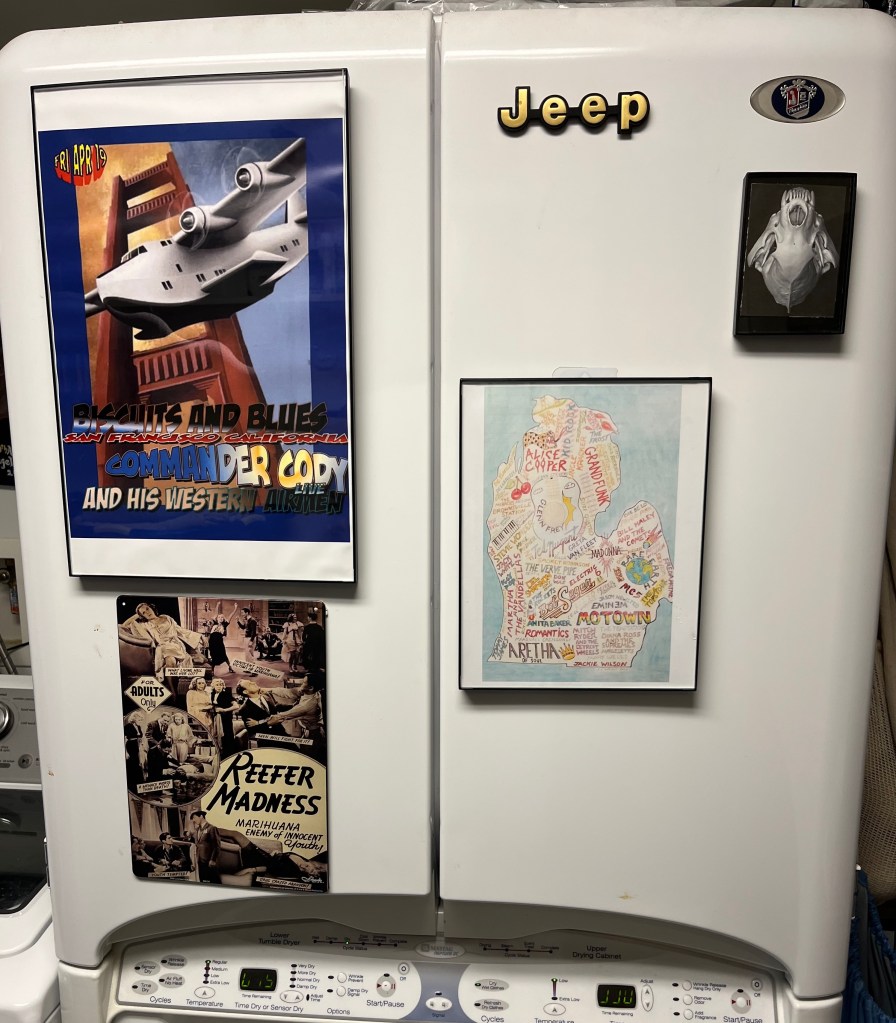
To the opposite wall, I’ve added a framed print of an advertisement Commander Cody’s manager took out in Rolling Stone. It was 1971, and they’d just appeared in a glowing profile there (3) and had just released their first album. George’s brother Chris, also a UofM art student, did the band’s art till he died of multiple sclerosis in 1998.

One final upgrade, technically not part of the mancave, is the big poster I hung on the door to the storage room, just across a small entryway to the door to the mancave. The little circular items toward the top are the poker chips the promoter used as tickets to the event.

Yes, all those great bands graced the revolving stage at the Goose Lake Music festival that first weekend of August 1970. Yes, I was there with 200,000 of my closest friends and we saw ‘em all. Just don’t press us for details. Some have called it “Michigan’s Woodstock”. Happening 13 months after, the organizers managed to avoid a lot of the gremlins that plagued the masses at Yasgur’s Farm. But the locals didn’t much like the swarms of drugged-out dirty hippies, so made sure the facility would never be used for such a thing again. It’s a campground now, but every August they bring a few bands to the stage to celebrate the memory. In 2016,“Glorious Noise” made a documentary – Goose Lake International Music Festival (4). Careful, it begins with several minutes of locals bitching about hippies. But there’s plenty of great music!
Those hippies are all grown up and headed over the hill these days. But, you can bet if they pass through my mancave, they’ll be clean!
References
1. Ike B. mancave! And so clean!! WordPress 6/9/25. https://theviewfromharbal.com/2025/06/09/mancave-and-so-clean/
2. Bentley Historical Library. UM Athletics History. Michigan Football. Michigan’s Winged Helmet. 2/23/2001. https://bentley.umich.edu/athdept/football/helmet/mhelmet.htm
3. Ed Ward. Interview: Commander Cody and his Lost Planet Airmen. Rolling Stone 4/16/70. https://www.rollingstone.com/music/music-features/interview-commander-cody-and-his-lost-planet-airmen-179296/
4. gdcrow. Goose Lake Festival 1970. YouTube https://youtu.be/o7RFG000QGo?si=btsnfBjptsdZ9aud.
When I started this blog over 5 years ago, I vowed to myself to stay clear of religion and politics. Like Albert Finney’s character in Big Fish said, “You never know who you’re gonna offend”. My dear late friend Sam taught me to lay off politics on Facebook, and I carried that into my blog.
You could take this post as a hard break from those self-imposed restrictions. But the events of the past few weeks have taken me to a place where I just want to share a bit of my emotional self. As huge a shock that Charlie Kirk’s assassination was, I guess Kathy and I are doing o.k. After all, funerals are there not only to praise the deceased, but also to remind us we’re still alive and there are a lot of like-minded people with us to carry forward those things the departed valued. Then two days ago came news that our favorite preacher – someone you’ve probably never heard of – passed on unexpectedly at 56. Voddie Baucham was raised by a single mother Buddhist in South Central LA, taking his big body to Rice to play football where he met Jesus. He went to seminary after graduation and has run his namesake foundation since 1993. He spent some time in Zambia starting up a school and was one of the founding faculty then Dean for Founders Seminary in Florida. My sadness at his passing dampened a bit when I saw the picture below. Boy, does Jesus have him some new blood!

Voddie delivered an apt sermon the day before he died. An abbreviated version was put up by an admirer (1), although there are a number of annoying commercial breaks.
If you cut 53 seconds into this tribute to Voddie, you can hear him talking about the “rumors” of his death (2). The remainder of the video is well worth the time.
His sermons were always powerful, and there are many out there. Richest source is his web page, Voddie Baucham Ministries, where the archive unfortunately stops at 2022 (3). And Voddie has an ample presence on YouTube.
Death may take the physical bodies of such great men from us, but their spirit and teachings live on. Sometimes it can take a death to get us to focus on those things they’ve been trying to tell us. By heeding them, we honor their memories. Our way should be clear.
References
No, I’m not tapping into Bud Light’s silly theme of a few years ago (1). A few weeks back, when the notion to write this just started, Mother Nature was easing along into the Michigan growing season. A trip to the Farmers’ Market found mostly prepared products but very little actual fresh produce. Michigan moves slowly, even in June, and after those glorious asparagus spears, there’s not much fresh out of the ground, although those strawberries make a splash. The peas come next, snap, shell, and snow. Some vendors shell out some peas, at a price. But seeing those peas, for me, makes me want to make that classic spring dish: dilly peas and new potatoes. Those itty-bitty potatoes show up about the same time. How convenient. The dish is an excellent accompaniment to any of those white fish you might want to saute or poach. I’ve included some recipes for this at the bottom.
Here’s the (well-used) recipe for peas and new potatoes. It helps that dill is coming up fresh about the same time.

But that recipe presents problems in our household. Early last year, Kathy signed up for the “PhD weight loss program” (1). There are many components to it, but clearly the glycemic index (rise in glucose produced by any food) is a target (2). Good bye starches, noodles, rice, and potatoes!
We’ve been rescued by another white vegetable, the cauliflowere (3). And such was to be by this late Spring treat. Here’s the alternative we came up with:

Trust me. I love me my dilly peas and new potatoes, but this is terrific.
Now that you’ve got that perfect side dish, how about the fish? If you’ve got a friend who’s handed you a fresh mess of perch, how about going all French on them?

Those slender white fish fillets come in many forms, but they all take well to a little nurturing in the pan. Here are 3 of my favorites.
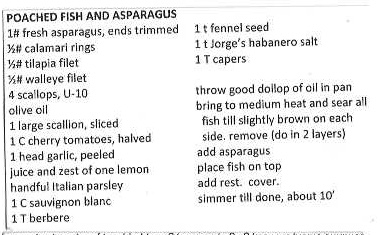
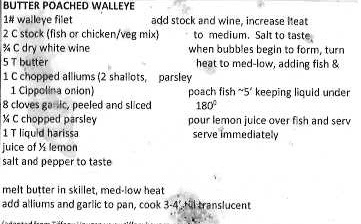

Should you come across a whole fish of one of these varieties, feel free to throw it on the grill. Back in the days when we used to camp on 12-mile Beach in the Pictured Rocks, we’d get whole whitefish and lake trout from the Indians, and I’d fashion a wood stick mesh to hold them over the fire. Tasty always, but there are many other ways to cook a fish.
References
1. Dale Kovar. The ENTIRE Bud Light – Dilly Dilly Saga!!. YouTube. https://youtu.be/7Nt1HrgjveI?si=FQSxPV3HAalc4osu
2. PhD Weight Loss. https://myphdweightloss.com
3. University of Sydney. Glycemic Index Research and GI News. https://glycemicindex.com
4. Team Ultrahuman. Cauliflower rice and glucose explained. 5/30/25 https://blog.ultrahuman.com/blog/how-to-access-your-hrv-data-on-apple-health/
Late Sunday we landed in Detroit Metro to conclude our second California trip in a little over a month. Hard to say when our pull to the Golden State began. My dad took me to San Francisco in 1964 to watch Barry Goldwater get nominated, and this 11-year-old was fascinated by the cable cars, architecture, terrain, Fisherman’s Wharf, the Golden Gate, the Bay, and the food. Hippies hadn’t come yet but I joined them in spirit a few years later. At every stage of my medical career, I applied to SF institutions, but the folks at UCSF and Stanford didn’t seem to want this Michigan boy as student, resident, or fellow. Kathy’s little brother Jimmy took his Ohio DeVry degree to Silicon Valley in the late 80s to land a job at Cognex for a career now entering its 4th decade. Of course, we stopped to see him when Kathy went to check out post-doc opportunities at UC Davis and UCLA. Fortunately, she chose to stay in Ann Arbor. Trips to the Bay area to see Jimmy and family were common. His 3 terrific kids were as close as Kathy and I were going to come to our own, so we treasured them. When I decided to take a sabbatical, I chose to spend it with my main ‘scopy buddy Ken at UCSD. So, we lived as natives through that frigid winter of 2017 (rarely over 60; the natives would apologize to us, between shivers). Revisiting La Jolla was such a pull, we looked seriously into buying a place out there. Of course, we wanted to be right on the water on Windnsea Beach, which pushes up the price somewhat. Our financial advisor finally pulled us off, stating we could only afford a California place if we sold our Ann Arbor house. Well, that’s not happening, so we rent. I reestablished connections with a couple of similarly twisted guys – both now practicing in the Bay area – with whom I’d served my residency time at Barnes Hospital.
So, the California Republic pulls on us in many ways. Our excuse for this year’s trip popped up last Fall, when Bill Kirchen announced he was pulling together all the living Lost Planet Airmen for yet another series of reunion concerts (1). Since I first saw them 4/17/71, I’m well into my second half-century of fandom. One show would be outside, at HopMonk Tavern in Novato, where we’d already seen the band twice before. Novato is just a half hour south of Petaluma, where my Barnes buddy Dave practices concierge after bolting from academic endocrinology at U Iowa. We’ve been including stops in Petaluma ever since Dave started inviting us to his “Safety Meetings”, held in the back room of his friend’s hardware store 5:15 PM every Friday (2). There, like minded guys (Kathy’s the only woman), gather to set right the ills of the world while nibbling on snacks and consuming various intoxicants. We haven’t taken to publishing our proceedings. Yet. Both Dave and I are very fond of Rajiv, our African American friend (born and raised in Kenya of Indian parents), who’s just retired from a practice in Walnut Creek, which Rajiv selected by looking at maps showing household income as well as density of rheumatologists. We’ve been inviting Rajiv to these meetings for several years, and he’s expressed his enthusiasm at being able to observe Caucasians in their natural environment but always comes up with an excuse.
So, we bought tickets on the spot and made arrangements for the trip, then long off. Per usual, we’d hang with the fam in Pescadaro, staying 15 miles away on the ocean in Half Moon Bay (3). We’d fly to San Diego and spend a few days on Windnsea Beach. Seemed like a plan till the young ‘uns stepped in. Jimmy has 3 kids, all home schooled and each college ready years before their peers. His oldest, Orion, was set to conclude his time as a banana slug, graduating with a degree in Geology from UC Santa Cruz. It wasn’t till April that details were settled, but his graduation wasn’t going to overlap with our concert, so we planned for a month earlier. That left a goodly portion of our previous plans superfluous, so we pared them down so our concert trip would be an over-and-back, in Friday and back Sunday.
That’s the trip from which we just returned. Since we made our plans on short notice, our usual haunts were booked. We stayed at a quirky little Petaluma hotel, the French-inspired Metro (4). They’d devised a clever way to expand their available lodging space on their tiny patch of ground. See here where we spent our two nights.

There were 2 other Airstreams on the premises. Each had a little poster attached. See ours. Let’s just say Kathy and I were comfortable. Morning’s fresh crepes and pour-over coffee enjoyed in the outdoor garden were a delight.

Wonders of Marin County were all around to experience, but since this was much a business trip for us, we stuck around to tend to those matters leading up to the Saturday afternoon concert. Kathy had brought a bunch of her children’s books. My book on the story of the band we were about to see was still in the hands of the publishers. I had 2 folders each with the most recent draft in case anyone was curious. I made up a couple dozen “teaser” bookmarks, with Kathy handed out to some curious old hippies as the concert came to a close. She sold almost all of her books, including some to Bill Kirchen’s wife Louise, who’s a grandmother after all.

The old hippies on the stage delivered a knockout performance. Guests Floyd Domino (Asleep at the Wheel’s original pianist, standing in for the late Commander) and Blackie Farrell (song writer and outlaw singer extraordinaire) taking things even higher.

Left to right: Floyd Domino (ex-Asleep at the Wheel), Dr. John Tichy (emeritus professor of mechanical and aerospace engineering at Rensselaer Polytech), Bill Kirchen (Titan of the Telecaster), Buffalo Bruce Barlow (on bass: the only Bay Area native in the band; he turned down an offer from Little Feat to stick with the Commander), Android E. Stein (fiddle & saxes, an eternal hot ticket on the NYC music scene; you heard him in the band on Prairie Home Companion for 10 years, movie too), and a missed name on pedal steel. LPA have been through a lot of pedal steel players, all capable. There’s a drummer back there, who also did a great job even if I’ve forgotten his name, too.
This is a special trip for Bill and Louise, as they lived in this area during the Commander’s heyday and were married in nearby Glen Allen in a magical ceremony 50 plus 2 years ago. Sure, it’s cooler here than in Austin Texas, but the draw is far deeper than that.

And no Bill Kirchen concert – Airmen or no – would be complete without his rendition of what was the the LPA’s signature song, their only “hit” by Billboard standards. Bill has taken the 1955 Charley Ryan song about that hot rod race to new heights with his guitar virtuoso embellishments (5). Dave has eclectic musical tastes like mine and knew all the songs the band sang. They’ll do it all again next year and I’ll be there for tickets as soon as they’re announced. Both Dave and I agree with the message from the first song of their set: “There’s a whole lotta things that I ain’t done, but I ain’t never had Too Much Fun.” (Austin ’74, videography added by the Commander years later: 6). Can’t stop us from trying! The band closed – before encores – with “Lost in the Ozone” (7), where I’m sure we all were by then. I was there when they recorded this track in ’71! Take me back!
References
1. Shapiro M. Bill Kirchen and Lost Planet Airmen take flight at 2 HopMonk concerts. The Press Democrat 7/2/25. https://www.pressdemocrat.com/article/specialsections/bill-kirchen-lost-planet-airmen-hopmonk-tavern/
2. M.Maselli & Sons Hardware. https://www.maselliandsons.com
3. The Oceanfront Beach Villa. https://www.theoceanfronthotel.info
4. Metro Hotel & Café. https://www.metrolodging.com
5. palliazzer. Bill Kirchen – “Hot Rod Lincoln” in Washington D.C. *UPGRADED*. YouTube. https://youtu.be/gsLdufJePz0?si=DB0nSaRV7Erl9yIw
6. Commander Cody. Too Much Fun Live. YouTube https://youtu.be/J0jWv0lFqF0?si=vYtBKA6ZW2er89nJ
7. stiblair. Lost in the Ozone Again. Commander Cody – “Lost in the Ozone”. YouTube. https://youtu.be/heK8QjhWGag?si=UV8InODH2Qk0LZ89
I started earning a regular paycheck in 1979 and have lived 5 places since then. At no point did I have a proper mancave till now. I had to exude toxic masculinity and smoke cigars all over the house. Since I have an understanding wife, a pretty big house, and don’t really smoke cigars anymore, there were no problems with this arrangement. But a combination of gifts and discovery of some treasures from my past combined to create me one, which I’m enjoying tremendously. But what corner of Harbal house was suitable for this purpose? I owe that to our builder, Gary, who in his plans for the grand redesign of our house in 2004-5 included the creation of a distinct laundry room. Till then, we relied on a washer and dryer behind some folding doors in the corner of our “lower level” (a.k.a. basement). Now, those replacement appliances are in their own room, still downstairs, where behind closed doors I can bring cleanliness to our household. Yes, I’m the washerwoman here. I’d told my wife several times of the affinity for mundane household chores I’d developed in med school, having recognized these tasks would mark rare breaks in my medical grind that I should learn to enjoy. Kathy didn’t wish to stand in the way of my pursuit of happiness, so happily let me take on the cooking and cleaning.
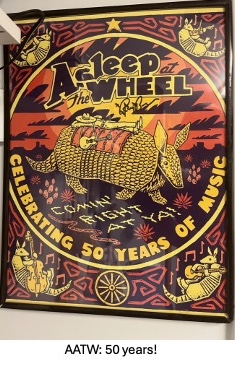
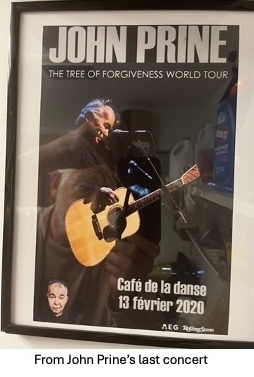
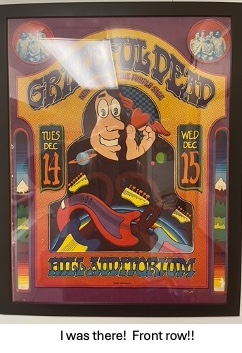
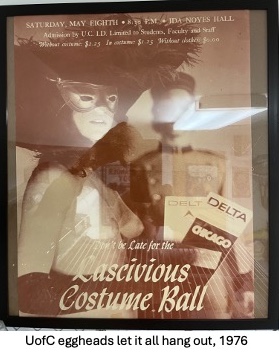
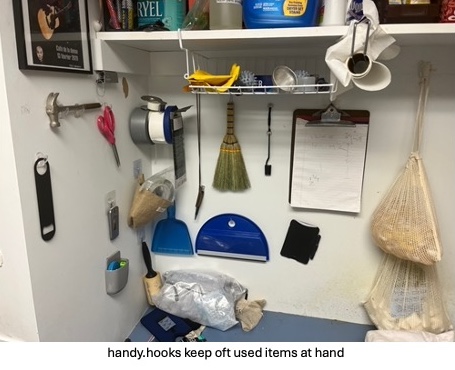
The decluttering effort we began in my retirement turned up some forgotten treasures, in particular our combined collection of over 400 posters devoted to space, music, and sports we’d accumulated over 50 plus years. The posters went up all over the place and we ran out of wall space. But what brought the room together was not the art, but an appliance. When Kathy was based in D.C. for NASA ’98-’02, we bought a nice Denon stereo for her. That ended up in her office here, but she rarely used it. You couldn’t get your choice of music from an iPhone at the turn of the century, but hers became her preferred source when in her office back here. Finally, the idea came to me it might be nice to have some CD music while folding. I found some floating shelves to hold the receiver and speakers and set it up. I also found an unused teak CD bookcase and hung it up. Just the new music studio itself was a joy, but the room needed decorations. I hung from the wall several items I might be using and would prefer not to have to run and get when needed. The biggest expanse of wall now holds a painting made for me by my St. Louis nurse friend who also paints and offered to create something from a treasured photo I’d had taken in Shirley MA after a concert by Bill Kirchen with Commander Cody as special guest. Right next to it is a poster from the last time I saw the Commander, at Callahan’s in Auburn Hills March ’21. Also up is a poster from Asleep at the Wheel, signed by 6’6” leader Ray Benson and celebrating their 50th anniversary, and 3 other concert posters: one from John Prine’s last concert in Paris February ’20 and from my student days, 2 colorful announcements of concerts by the Allman Brothers and the Grateful Dead. The 6 non-music posters start before you enter the room, with a colorful spacy poster announcing the “Future Worlds Lecture Series” of 1971. Luminaries like Buckminster Fuller and BF Skinner appear. I included one from my UofC days (for the “Lascivious Costume Ball”, featuring a bare-breasted co-ed); the UofC president shut the event down in ’84 but it was revived in ’08 (1), from my dorm wall (an instructive illustration of the many forms of hashish), a print from my artist brother Marty depicting his stock character wishing he were a cowboy (2), a photo from Vicksburg resident Jeanne Church of a Great Blue Heron in flight, my spirit bird (3), and a framed postcard-sized print of a wolverine’s skull, courtesy of UofM’s Museum of Natural History (4). Most recently, another dorm wall poster arose, this one a cartoon of a hippie with some pirate characteristics announcing. ”When you’re smashin’ the state kids, keep a smile on your face and a song in your heart”, likely lamenting even then the humorous lessness taking over the revolutionaries. These hippies begat the modern leftist movement, which still suffers this humor deficit.
So, you can imagine how happy I am down there folding socks, listening to tunes under a good stereo under the watchful eye of George Frayne IV (a.k.a Commander Cody) and Mr. Prine. One unexpected consequence is that my music carries up the laundry chute to the master bedroom area. Could disturb whomever might be trying to rest there. Turns out a pillow jammed up the chute takes care of the problem. All our clothes are clean and nicely folded these days, and I never allow them to get too dirty, as I’m always seeking excuses to occupy that room, my new mancave. Let me know if you know any other men with such an arrangement.
Here are some pics of my surroundings there:






References
Appendix: actual poster sizes (W X H)
Cody by Angie 30X24
Cody @ Callahans 24X30
The Wheel’s 50th 12X17
Prine’s last 9X11
Allman Bros 18X23
Dead @ Hill 18X24
Future Worlds 18X23
Lacivious Ball 12X14
Hash 18X23
Marty’s cowboy 8 ½ X 10 ½
Wolverine skull 4X5
Smashin’ the state 18X23
Now all of you who just completed that phrase, raise your naughty little hands! No, this isn’t a treatise on childhood snigger porn – good one for later – but results of my cost analysis of making that classic summer refresher.
My motivation was my rediscovery of the Arnold Palmer drink as part of my continuing quest to find substitutes for beer. I think ol’ Arn often put a couple shots (he preferred Ketel One) in his tea and lemonade on the 19th hole, but it’s very enjoyable without (1). The stuff is available in cans everywhere, but it’s so simple to make, why put up with the empties (cans and your wallet)?
Even though Palmer was among the first pro athletes to commercialize his name on a long line of sports and apparel products, I don’t believe he trademarked his name for his signature drink. His trademark signature/umbrella logo boldly emblazons every container of AriZona Tea’s version (2), so I think Arn’s descendants are doing o.k. People have enjoyed Arnold Palmers for decades without paying an extra penny for his name. AriZona beverages started putting the drink in cans in 2001 and now sells 400,000,000 cans annually (world).

Per Wikipedia, Arnie preferred his drink 3 parts tea to one part lemonade (1), but the universal recipe is half-and-half. Indeed, that’s the name given to the drink by those who eschew eponyms. You can get the deep story straight from the source on Arnie’s webpage (2). The spiked version is often called a John Daly (3). Miller Cohrs sells a drink called “Arnold Palmer Spiked” (4), but the alcohol comes from a fermentation of malt (Ketel One is a Dutch product made from 100% European winter wheat, and some other vodkas come from potatoes. But no malt for vodka, that’s for beer). But alcohol is alcohol, and who cares if the spiking juice came from distilling a brewing batch otherwise slated to be Cohrs Light? The brand’s been very popular, outstripping “Twisted Tea” as the #1 canned alcoholic tea (4).
I just made my last (non-alcoholic) batch with a half gallon of tea from 10 bags at room temperature plus a half gallon of prepared lemonade that was on sale at Busch’s.
I decided to make a fresh batch before writing this and tally up cost and calories for various methods of preparation. I live in a food jungle, not a food desert, with the 2 mile stretch of Plymouth from my house East to US-23 populated by 3 major grocery stores (Kroger’s, Busch’s, Plum), 2 very good ethnic groceries (Chinese, Indian), and 3 party or convenience stores. If I want to reach out, Yelp tells me that within 2 miles of my address are 5 grocery stores, 4 ethnic markets, 4 delis (including Zingerman’s!), 2 butcher shops, 1 fishmonger, 10 party/convenience stores, and of course the Farmer’s Market, convened just 1.2 miles away every Wednesday and Saturday morning in season. We eat well in Tree Town.
I decided to go to Busch’s, the middle brow of my nearby groceries. If you want to stock up your lemonade factory, here’s what you’ll need, along with prices I paid:
Lemons: $2.99/2# bag of 6
Sugar: $4.99/5# Pioneer beet sugar
Stevia*(liquid): $9.79/2 fluid ounces -> 12 tsp -> equivalent to 12 C sugar
and if all you want to do is open a container:
ReaLemon: $3.79/32 oz, enough for 42 8oz regular lemonade, or ~9¢/serving
frozen lemonade concentrates: $2.79-$3.49/12 oz: 47¢-58¢/8 oz serving.
commercial ready-made lemonade: ranges $2.99/64 oz to $4.29/32 oz, or 37¢ – 98¢/8 oz serving
There’s a lotta sugar in traditional lemonade, ready to fatten us up not to mention the many other ways it slowly poisons us. Of all the low-cal sugar substances, only stevia is a plant-based product. All the rest – like aspartame, sucralose, saccharine, and the US-banned cyclamate, are generally not considered as healthy due to potential side effects and lack of nutritional value. The Mayo Clinic has summed up those choices nicely (5). Stevia is derived from the shrub Stevia rebaudian, native to Paraguay (6). The plant extract contains glycosides. These glycosides, extracted from the plant’s leaves, including stevioside and rebaudioside A, are diterpenes with a common backbone structure called steviol. These two are the main sweet components and are significantly sweeter than sucrose (table sugar), typically by a factor of 250-300. Those diterpenes tickle “sweet” receptors without raising glucose or insulin levels, a boon to the pre-diabetic with a sweet tooth (7). As with all non-sugar sweeteners, stevia consumption alters gut flora a bit. That plus some other adverse effects have led some to question whether the compound deserves its place on the FDA’s GRAS (generally regarded as safe) list (8). Maybe it’s true what they say (9). It’s easy to find and seems pricey until you consider how potent the stuff is. Amazon features 7 pages of options (10).
Lemonade’s a pretty simple recipe, but I hadn’t made my own from scratch for a very long time, so I had to look one up. I went to the bible that has guided my cooking from the very start, Rombauer and Becker’s Joy of Cooking, first published in 1931, and still in print (11), Doctor’s daughter and lawyer’s widow Irma Rombauer’s first go with a trade publisher came in 1936, and you can get a used copy for a mere $549.95 (12). Getting the best-selling cookbook of all time (over 20 million copies sold to date) off the ground was no piece of cake, as it were (13). The 90-year-old cookbook has a bright future, as the trad wives of gen Z have taken to it big time (14). With the current edition, at 1200 pages and 4.6 pounds, you certainly get your money’s worth, especially at Amazon’s current price, nearly half that of list (11).

Reinforcing what a bargain this is, my aunt’s 1964 edition set her back $6.50, or $68.20 in today’s dollars. This latest edition was revised and expanded by Irma’s great-grandson John Becker and his wife, Megan Scott. You could say the boomer generation was fed from it, at least the lucky ones. You can still get a replica of Irma’s original self-published edition, only $16.95 on Amazon (15). My mom and Aunt Dorie both found it indispensable, and I inherited both of my aunt’s hardbound copies, one I had given her for as a Christmas present. When I went off to school, I bought my own copy as a pair of paperbacks, which still sit on my kitchen bookshelf, ever shedding their covers to be taped back on
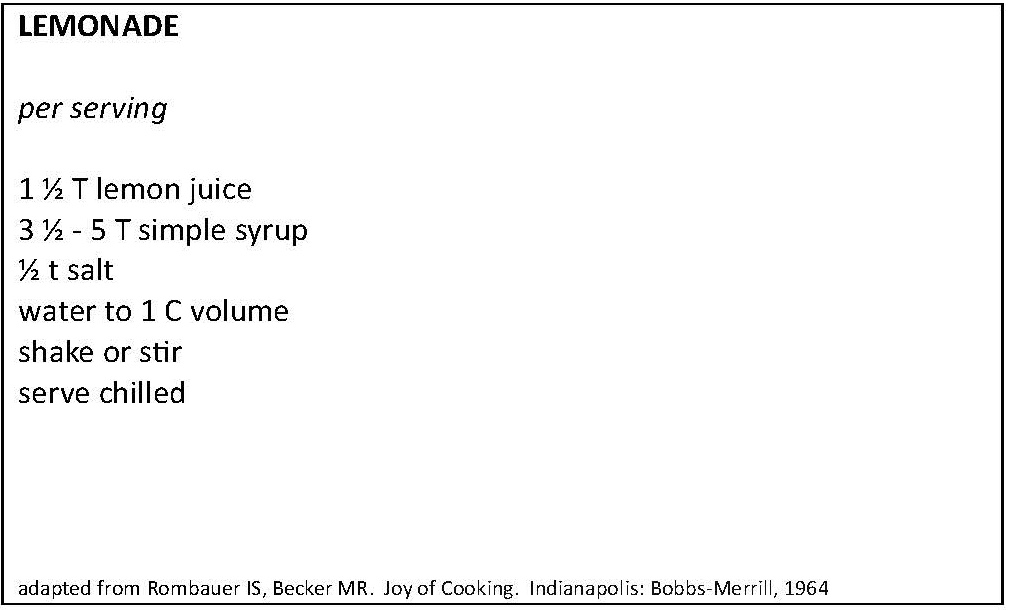
So, here from page 34 of my aunt’s book are not just one, but 3 recipes for lemonade.

Only the first is in my paperback. The extras could be helpful if you’re feeding a crowd or seeking convenience.
So how do these data translate to a better lemonade/Arnold Palmer experience? Below, I’ll show the several ways you can do this, accompanied by cost data so you can do it with thrift.
The key to the several recipes I’ll list below is the sweetener. Even that’s controversial, as some like their lemonade sweeter than others. That’s one beauty of making it yourself, as you can control the amount f sweetness.
The Joy of Cooking recipe calls for just plain sugar. But read the fine print and see you first must boil the sugar in water then let it sit to cool. Basically, you’re making “simple syrup” (16). This bartender’s staple is simply a 1:1 sugar:water mix boiled then set to cool, usually for a later day. It’ll keep for a month in the fridge. Since sugar in water takes up half the space it would as a solid, the resultant mix contains per volume an amount of sugar equal to about 1/3-1/2 more than a solid
measurement would yield. So, if you want 1T sugar, use 1 ½ T simple syrup. I’ve checked this out myself, on my own batches, and these proportions hold true.
The stevia is a little more complicated, as it is so potent. You never use much, and I recommend you titrate up. The nice folks who make Stevia Have provided a helpful conversion chart (17).
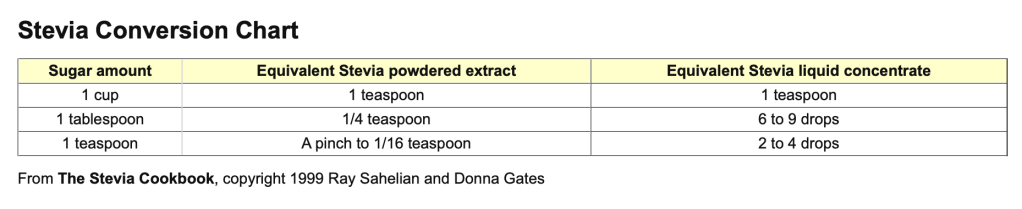
While Stevia come in a liquid form, mostly it is sold as granules, looking a lot like table sugar. A recipe for ginger ale at their site uses stevia to make a syrup, which is boiled then cooled, a lot like simple syrup (18). For fun, I also made the lemonade syrup recipe shown above, only with Stevia. Despite US approval, the World Health Organization frowns on stevia (and all artificial sweeteners), recommending consumption of no more than 4mg/kg/day (19). So, if you’re a typical 70kg (154#) American, you could throw back 58 of these stevia-laced 8 oz lemonades/day. As a supersized person (250#/114kg), I could look forward to a day with 91 quaffs. Remember, everything in moderation (including moderation, per Oscar Wilde).
It’s less complicated for the lemon juice, if not entirely so.
Calls for “juice of one lemon” don’t always denote size of lemon or volume of juice yielded. Lemons are characterized by a 3digit number, which denotes the number of lemons that size that fit into a shipping case: 240 to 540. Michigan State has produced a nice guide, which includes this illustration (20 (). The small print may be hard to read, but range of sizes is clear.

Dr. Google tells me from several sources that an “average lemon” yields 2-3 tablespoons of juice. If you’re fond of metric, here’s a nice thorough reference (21). In it, the author reminds you can increase the juice yield by gently rolling and/or briefly microwaving each fruit before squeezing. I’ve stuck with actual volumes of juice in my recipes. I got 135 ml of juice from my 2 larger lemons, which together weighed 14.3 ounces (450 gm). I juiced half my 8-bag of smaller lemons – which weighed 12.8 oz (363 gm) – and got 205 ml. So, on a juice/lemon weight, I got a better yield from the smaller ones, this time. So, with 45 ml/8 oz cup of lemonade, I’ve got enough for 7 ½ glasses. Note that the lemonade syrup uses some rind, so not all that precious zest flavor goes to waste. But do you really need to do all that squeezing when there’s ReaLemon? While bottled juices have most of that lemon flavor, they just don’t have the zest of fresh-squeezed (22). The author of that article reminds that leftover lemon juice can be frozen in ice cube trays for later use.
Now, first, the recipes, then the breakdown. No need to duplicate the recipes using straight sugar, but I do include those in which I used simple syrup.
First, the basic lemonade. Note there is no boiling involved, and the volume here is just one cup. Now, the basic recipe using Stevia. If you don’t have the liquid Stevia, you’ll need to go through a boiling step.
Finally, the syrup recipe using Stevia. Handy to have, as you can whip up fresh lemonade on demand in mere moments.

I like this for the convenience as well as the use of lemon rinds and of course the 3 calories per 8 oz serving. You can use it for an Arnold Palmer at least a couple ways. You can just make up the lemonade and mix it with tea, or you can pour the syrup right into the tea. I make mine in a half gallon jug. If lemonade should occupy half that jug, I’d pour in 4T of syrup to a jug half-filled with tea. After that, I can get a little creative, approaching the mix Arnie originally preferred (3 tea: 1 lemonade). Regardless of how you got there, that homemade Arnold Palmer can of course be adulterated further. Remember the John Daly? Just add 2 shots of vodka. Now with that stevia, haven’t we come up with a “diet” drink? With 12 oz of drink and 2 shots of 80-proof vodka, there’s 194 calories, add 5 for the lemon, packing a 24-gram alcohol punch. That’s about the same punch as my favored drink, a 12 oz 7% IPA. Remember, much of my motivation for this project was weight loss, and beer was a huge factor in my weight gain. Calories in that IPA? 220/can (23). Not much of a delta. And my carb-counting wifey tells me lemons have a glycemic index of 20. With each pound of fat accounting for 3500 calories, I’d have to quaff 167 John Daly’s in place of beer to lose a pound. That could take weeks! But every little bit helps. I could drink the Arnold Palmers without the vodka, but where’s the fun in that?
For those recipes in which you’re basically adding water, you can fancy things up by using something sparkling. If you don’t want to fuss with all those empty bottles and cans of club soda, La Croix, Perrier, or whatever , check out the SodaStream. This nifty Israeli product produces unlimited bottles of sparkling water provided you keep its CO2cannister filled (24).
Now, go whip up some so your kids can sell it from their stand out front! You can help them set their price point, using the data below. From what you get, you may want them to push it as a gourmet item. Would probably be a hit in Ann Arbor. Free range, organic, and sugar-free! Oh, and artisan!!
References
1. Arnold Palmer (drink). Wikipedia 3/19/25. https://en.wikipedia.org/wiki/Arnold_Palmer_(drink)
2. The Legendary Arnold Palmer Tea and Lemonade Beverage. arnoldpalmer.com. https://www.arnoldpalmer.com/beverages
3. Kelley B. The John Daly Drink: Recipes, and Why the Cocktail Is Named for the Golfer. About.com|about sports. 4/7/15 https://web.archive.org/web/20150407010827/http://golf.about.com/od/golfentertainment/a/john-daly-drink.htm
4. Arnold Palmer Spiked. https://www.arnoldpalmerspiked.com
5. Mayo Clinic Staff. Artificial sweeteners and other sugar substitutes. Mayo Clinic Healthy Lifestyle. Nutrition and healthy eating. https://www.mayoclinic.org/healthy-lifestyle/nutrition-and-healthy-eating/in-depth/artificial-sweeteners/art-20046936
6. Adams P. What exactly is Stevia? Ask Paul. America’s Test Kitchen 8/16/23. https://www.americastestkitchen.com/articles/7451-what-exactly-is-stevia-ask-paul?extcode=KGNAM0024&utm_medium=cpc&utm_source=google&utm_campaign=Non-Brand%7CArticles%7CDSA&utm_term=&utm_content=s%7Cpcrid%7C722241849592%7Cpkw%7C%7Cpdv%7Cc%7Cpmt%7C%7Cproductid%7C%7Cpgrid%7C168623015217%7Ccpgnid%7C21919947981%7Cptaid%7Cdsa-2398028914799%7Cadext%7C%7C&gad_source=1&gad_campaignid=21919947981&gbraid=0AAAAAD-Lx3oYZXtandg2Ngk2ti4s-MP3F&gclid=Cj0KCQjwotDBBhCQARIsAG5pinNlpyBCR6T7m1QwevoBiEIjI6_92J516Cu9W5sTnljtE8g3mOB5w0UaAlrDEALw_wcB
7. Momtazi-Borojeni AA, Esmaeili SA, Abdollahi E, Sahebkar A. A Review on the Pharmacology and Toxicology of Steviol Glycosides Extracted from Stevia rebaudiana. Curr Pharm Des. 2017;23(11):1616-1622. doi: 10.2174/1381612822666161021142835. https://pubmed.ncbi.nlm.nih.gov/27784241/
8. Drobberstein LG. Stevia – The Dark Side of the Natural Sweetener. Wellness resources 6/15/20. https://www.wellnessresources.com/news/stevia-the-dark-side-of-this-natural-sweetener?gad_source=1&gad_campaignid=21456989439&gbraid=0AAAAAD_p1BOSA-g3xE3m-GGe-AdSi7fCp&gclid=CjwKCAjwi-DBBhA5EiwAXOHsGbamh0VqU8NSoRh_QVrDwe5B0C8sB5MkbRM7ym57BJnwRdDTFTo0VxoCixwQAvD_BwE
9. bbiermanster. It’s not nice to fool Mother Nature! YouTube https://youtu.be/j12J3PCai5A?si=_sobZAJyUGuarEkC
10. Stevia. Amazon.com. https://www.amazon.com/s?k=stevia&crid=2VH13VHQQ4CFM&sprefix=stevia%2Caps%2C151&ref=nb_sb_ss_p13n-pd-dpltr-ranker_1_6
11. Rombauer IS, Becker MR. Joy of Cooking: Fully Revised and Updated. New York: Scribner 11/12/19 https://a.co/d/awwfZAP
12. Rombauer IS. 1931 Facsimile Edition: A Facsimile of the First Edition 1931. New York: Scribner 4/29/98. https://a.co/d/i6J4A4e
13. Gordon JS. The Back Story of “The Joy of Cooking”. American Heritage 49 (2): 4/98. https://www.americanheritage.com/back-story-joy-cooking
14. Moe A. Let them cook. The Atlantic 12/6/23. . https://www.theatlantic.com/family/archive/2023/12/gen-z-cooking-hobby-tiktok-pandemic/676214/
15. Rombauer IS. The Joy of Cooking. Indianapolis: Bobbs-Merrill, 1936 https://www.rarebookcellar.com/pages/books/322608/irma-s-rombauer/the-joy-of-cooking?gad_source=1&gad_campaignid=290956452&gbraid=0AAAAAD0VZQrMY3sOdfbHreos6teykbLJi&gclid=Cj0KCQjwotDBBhCQARIsAG5pinPR6l94GtYPiFunbTBdHfrP2TXdhFQNwnj6bflCqki-ta1pCLz2REoaAlh-EALw_wcB
16. Shaggy. Simple Syrup. Allrecipes 11/14/24. https://www.allrecipes.com/recipe/20216/simple-syrup/
17. Stevia Conversion Chart. STEVIA.NET https://www.stevia.net/conversion.html
18. Stevia Ginger Ale. STEVIA.NET https://www.stevia.net/morerecipes.html
19. World Health Organization. Use of non-sugar sweeteners: WHO guideline. 5/15/23. https://www.who.int/publications/i/item/9789240073616
20. Keep This Handy California Orange and Lemon Size Chart. MSU Libraries https://lib.msu.edu/sliker/load_object/8601/pdf
21. Hartleib A. Lemon juice – the all-rounder for the kitchen, bar & co. HONEST&RARE 4/3/24. https://www.honest-rare.de/en/magazine/lemon-juice-worth-knowing/#:~:text=On%20average%2C%20a%20lemon%20contains,to%20increase%20the%20juice%20yield.
22. Lemon Juice. Why fresh is best. Good Food for Good. https://goodfoodforgood.ca/blogs/recipes-with-simplicity/why-you-shouldn-t-buy-bottled-lemon-juice-fresh-is-always-better#:~:text=Fresh%20lemon%20juice%20offers%20a,lemons%20their%20distinct%20citrus%20aroma.
23. How Many Calories in a 12-oz IPA? Your Complete Guide to Beer Calories. New Trail Brewing. https://newtrailbrewing.com/how-many-calories-in-a-12-oz-ipa-your-complete-guide-to-beer-calories
24. Sodastream.com
Appendix
cost per batch – syrup
lemons: $2.99
stevia: 82¢
batch total: $3.81
16 servings/batch: 21¢/8 oz
I spent a little time last week in the village where I was a teen, Vicksburg. The occasion was the awards ceremony for the Southwest Michigan Tournament of Writers. I’d received dispensation the year before from the director to enter, even though I was not a local. The stipulation was that I confine my writings to Vicksburg. I did, and managed to win an honorable mention in my age group (1). I tried again this year with a heartfelt recollection of my ‘burg years and the events that had brought me back to the village. No repeat performance, although there was more competition this year with more entries and collapse of the senior and adult categories into one group. There were over a 100 entrants all told and 15-20 in my category. Fortunately, Vicksburg Arts compiles all entries into a book they sell on Amazon, so at least I got another chit for my CV. You can read my entry if you send Amazon 12 bucks for the book* (2). From judges’ comments, I learned my entry was poorly proofread (guilty!), sometimes imprecise and sometimes rambling. I may have approached achieving their word count a bit too vigorously. I’ve taken those comments and fixed up my entry, which is what you see below.

My life would have turned out much differently had not fate landed me in Vicksburg, and I am forever grateful. Perhaps by reading the following, you’ll understand why.
Head in Tree Town, Heart in the ‘burg
How’d I get to Vicksburg? Remember those dog food commercials in the 80s that featured that cute rambunctious bulldog (3)? This Ike was sure a lucky dog when in ’64 the Fisher Body brass kicked my dad from the Tech Center to Comstock to raise their biggest metal stamping plant ever. Dad’s eagle eye caught a red shingle ranch on the North shore of Barton. Thus began my 5 years in the ‘burg, where the teachers, coaches, students, friends, and neighbors helped me grow from the shy fat boy bullied by the cool kids in Birmingham, to the tallest (and skinniest) player in the Wolverine Conference who graduated almost at the top of his class then headed to Ann Arbor to attend U of M.
Tree Town wasn’t heaven – studying was expected – but it came close, establishing. Hold that lasts to this day. Nearly everyone there is from somewhere else. True “townies” can name the AA elementary school they attended. I’ve spent 47 of the last 55 years here, and, as occupants of our ’58-built house since ’85, Kathy and I are seniormost members of this 13 house neighborhood, the two other families claiming longer residence both second generation owners. Still an Ann Arbor (AA) outsider, me, like my wife, born of Michigan grads (in Ohio), faithful football season ticket holder since ’64, recipient of 3 post-graduate UofM degrees, and 28 years of University paychecks. She can only count 44 years of Tree Town living, interrupted for those 4 years in D.C., but that’s another story.
I came to Vicksburg as an outsider, too. Boy, did Vicksburg take me in. Leaving wasn’t hard, as look where I was going! Shortly after joining UofM faculty, one of my colleagues – Bruce Richardson, a small-town boy himself – said to me “Bob, a lot of smart people come out of small towns, and the smarter they are, the faster they come out”. Not a completely nice comment, but it sure would have fit that tall guy headed east in ’70.
Things went o.k. in AA. While resisting the siren song of hippiedom, hearing a lot of great music, I shed my flirtation with law school and dove into the math and science that was my strength. That worked! On to med school! “Where you from?” in AA or Chicago – was an innocent conversational opening, not a “microaggression”. Students meeting anew quickly learned each other’s origins. Not everyone was from them ritzy Dee-troit suburbs. Some even hailed from a Wolverine Conference town! When one’s origin was sufficiently unique, nicknames were born. Yes, I was called “Vicksburg” a few times. It coulda been worse. One guy on our floor from Marlette, up in the Thumb (2020 census pop’n 1855), tried to tell us that his town was a pretty big place. Henceforth, he was “Big City”.
I never tried to hide my small-town roots. Hard to do with those weekly reminders, the Commercial delivered to my dorm room. My more-sophisticated hall mates got many a snigger from reading about the goings-on. I taunted a couple old girlfriends for a while, went to parties back in Kalamazoo, and had some VHS friends up for concerts. Summers were in Kalamazoo, working in that plant my dad helped establish. Dad sold the Barton Lake house after I went to AA. Living with Dad, I still could hang with some of the same gang that was still around.
Those easy jaunts to the ‘burg – either 15 miles from Candlewyck or 100 miles from AA – disappeared after I was admitted to the University of Chicago then matched to Barnes Hospital in St. Louis. Learning medicine over those 8 years didn’t leave time for much else, especially trips home. My fellow residents were all top-of-the-class eggheads, so the competition was fierce. Sharing details about one’s beginnings helps humanize, keeping our heads from blowing up. Curiously, most of the guys I called buddies were also from small towns.
In St. Louis, there was some time for the radio, and I never missed those Saturday late afternoon broadcasts of Garrison Keillor’s “Prairie Home Companion”. His tales of the quirky, stubborn, resilient, sneaky-smart, and life-loving residents of Lake Wobegon took me right back to the ‘burg. Garrison’s gift is to portray these small-town folks not as helpless rubes, but as special, unique, and lovable individuals, people you root for. Imagining I could fit into some of his stories, I came to feel more and more comfortable – and proud – being a small-town midwestern boy. My first chief at UofM, Giles Bole, grew up on a farm outside Battle Creek. We both talked with that midwestern twang. Giles was a hotshot researcher, invited to take his show on the road to places like Stanford and Harvard. He said he turned up his twang for those Harvard eggheads. Hearing him talk, they figured he wouldn’t have much of anything intelligent to say. Then his superior intelligence kicked in, and what he said was appreciated, understood, and unexpected.
Then, as Rodney Crowell sings in “It ain’t over yet” (4): “I got caught up making a name for myself. You know what that’s about.” It was my dream to become a Professor of Medicine at my beloved alma mater, and here I was on track to do it. I neglected all sorts of things while I had my nose to that grindstone. I thank God for my dear wife, who stayed with me while chasing her own dream, and the few remaining members of my little family who stuck with me. And thank goodness you can’t keep those Vicksburgers down. I missed the 10threunion as I was on-call. VHS70’s class president Steve (a.k.a. Hummel) began to throw parties for our old crowd, usually at his house, but sometimes at a local restaurant. Fun, and nobody gave a crap about my credentials other than to remind me how I screwed myself out of being class valedictorian, losing by 7 ten-thousandth of a point (5). Our class’s insult artist, Ott, took to calling me “Mister Ike”, not buying my explanation that that title would be appropriate were I a qualified surgeon in England.
My best friend from the ‘burg, Eric, lived many places after graduation, rarely near me. After one of his moves back to Michigan, he found himself in this area so came to my house. I was at the hospital when he knocked on our door. Kathy answered, and Eric followed his introduction with a pitch for subscriptions to several magazines he said he was selling, blowing his cover when he burst out laughing. We’d have some great times over the years, sharing a house on Lake Bellaire Memorial Day weekends, often a dip in Eric’s pool around Labor Day, and a small boat cruise of Alaska’s inside passage plus trip to Denali in 2014. Like a good friend should, Eric often improves on my ideas. When the 30th reunion was rolling around, I suggest we rent a place on Indian Lake for the week before . We can do better, he said, and we spent a week driving and hiking around the Keweenaw.
All well and good so far? Clearly my years in Vicksburg gave me a solid foundation for my brain, and for my heart, many friends and many wonderful memories, except maybe one. But I gave that one little thought till my retirement. Free from having to get up, put on the white coat, and go see patients, I quickly got into that favorite retiree sport: not pickleball, but decluttering! Guided by Magnuson’s The Art of Swedish Death Cleaning (6) and Washtenaw County’s on-line guide “Trash to Treasures” (7), Kathy and I went at it. We didn’t send Marie Kondo any money, but invoked her “joy, no joy” test frequently. One medium-size box brought plenty of joy, till I got to the bottom of it. Marked “Vicksburg Items”, it contained some little trinkets from those times, all my English papers (complete with Mrs. Pharriss’ red ink), even a handful of George Wallace for President pamphlets. Then, on the bottom, were several sections from the Kalamazoo Gazette and the Vicksburg Commercial. Yellowed and brittle, as you’d expect a newspaper from 1968 to be, I knew the story right away from the pictures, long before reading. My friend, classmate, teammate, and namesake Ike had driven his dad’s station wagon, containing Ike’s teammate Pat and 3 boys from the class of ’68, right into the path of an eastbound Grand Trunk freight. An event from over 50 years ago I thought I’d forgot is one for which I recall every detail as if it were yesterday. After wallowing all morning in that sorrow and loss, I recalled that I’ve found it helpful to write about troubling things, helping to make sense of them. The late Detroit Free Press cartoonist Guindon had one with his characters sitting at a table, pen in hand, staring off into space; the caption “Writing is God’s way of showing you how sloppy your thinking is”. My way was set. I would go and learn all I could about this event then write it up. Too big for my new blog. Maybe a magazine featuring Michigan stories? Maybe a book, if I write enough words? But what I could tell with the words I’d be generating at that point would have too many holes. Some field research was necessary. The train from AA to Kalamazoo was familiar from visiting my dad in hospice. I knew the choo-choo was the way to go-go, particularly with the 3 hours round trip giving sitting time rather than fighting the traffic on 94. The Radisson ”spaceship” was 2 blocks from the train station, and Enterprise rent-a-car would meet you at the station and take you to their place 3 ½ miles west on W. Michigan, where you’d pick your car, repeated in reverse. The Kalamazoo public library was 3 blocks away, and there were microfilmed Gazettes chronicling events of that fateful week. 15 miles south is the ‘burg. I was pretty sure their District Library would have old Commercialsbut couldn’t find any in their on-line catalogue. Instead of just looking for myself, I asked Eric for advice, who said Sue
would know. She was editor of South County News (SCN), the monthly that replaced the Commercial. She did plenty of scut for her dad Meredith Clark, publisher, back in the day. She directed me back to the VDL, and there they were. Sue liked my mission, met us at the library, took pictures, and wrote me up! (8). She was such a wonderful person, so full of life at 80, always interested and always interesting. I counted her as a new friend. Then she died, suddenly and unexpectedly. Her SCN solicited remembrances and published mine (9).
Could he fate of my collaborators made some of my classmates reluctant to talk about the accident? No, it wasn’t that. Knowing I could milk my ‘burg crowd for reminisces and insights, I arranged on each of my trips to meet as many as could respond to my invitation to gather at some restaurant in the area. I wasn’t forceful in how I conducted these “meetings”, but I had my briefcase full of clippings to show and did. My friends reminded me of many things I had forgotten or never knew. There were more and more quiet stretches and subject changes with each meeting. Finally, when it was just me and him at the table, Jim put it to me “Bob, a lot of people just don’t want to hear about this thing anymore.” I guess some people deal with past events by shutting out painful ones. Not me. I was accused by one of my psychiatry instructors of having a “hydrodynamic” theory of emotions. Still do. Negative emotions are like pus: need to be drained when encountered. When I figured my ‘burg sources had run dry, those train trips stopped. Some additional information came from unexpected sources. It turned out that the lawyer solicited by the 4 boys’ families suing Grand Trunk was the father of Sam, also a lawyer, and my friend since we met as freshmen on the 4th floor of Chicago House, West Quad. He directed me to the county clerk, who got me the court records from the Grand Trunk trial.
That was plenty to go on. The book practically wrote itself, although it came up kinda short. I couldn’t find a magazine I thought would take this 2,338-word article. Jeff Bezos has been a pal, publishing 8 (and counting) of my books (10), but found this first one too short for a paperback. Amazon does offer a Kindle, free. I’ve printed up a couple runs, the first in time for VHS70 50th. I left them in the car but made copies available to the interested. Several were. Copies sit in several public libraries – Vicksburg’s, Schoolcraft’s, Kalamazoo’s, and Ann Arbor’s – and the Vicksburg Historical Society, and are available through Docere (11).
So, I consider the book a success, even if Mr. Bezos hasn’t written me any big checks. While the pain of that fateful time in October ’68 won’t ever go away, I now have a much better grasp of those events, and a feeling for how they shaped us. Moreso, re-engagement with the ‘burg: the people, places, and memories have been precious benefits. COVID influenced everything those days, curtailing the research trips, but also getting me to Zoom with my classmates monthly leading up to our 50th. I volunteered to set up the meetings as Zoom is part of the software the U gives me. Hummel (class president Steve)got me the class list and I was off and running. Since I didn’t screw it up too badly, Hummel passed me the torch for organizing our 55th!
I get to the ‘burg a lot these days. Kathy seems to like my friends, at least most of them, and we’ve met some wonderful people. I even roused up an old teacher for her to meet, finally getting youthful nonagenarian Mr. Horn out his lair on XY. My basketball coach, he still insists he was right not to play me, even when I’m buying his beer. Of course, Mr. Horn likes Kathy. He always had an eye for pretty girls. We’ve done “Christmas in the ‘burg”, hit beers-and-brats, attended baseball and basketball games (I enter free thanks to a senior pass from Mike Roy) , gone on a “Historical Vicksburg” tour, attend services at VUMC (Vicksburg United Methodist Church) whenever in town, always hit “Something’s Brewing” (whose proprietor Heather we befriended when she had a shop on South Street downtown), and of course Distant Whistle. I even get my haircut at Getty’s! As I hinted before, Kathy likes the ‘burg. For her birthday 3 Julys ago, I bought her something from an ad in the SCN, a glamor photo shoot by Linda Hoard (12), who’s niece-in-law to my classmate Kevvie. Kathy’s a writer, too, and has pitched and sold her children’s books at Gilbert & Ivey. We’ve even given thought of getting our own Vicksburg getaway, to the point of spending an afternoon with a realtor looking at lakeside properties. The meeting with our financial advisor which followed got the sober recommendation that we could swing this only if sold our Ann Arbor house. No way that’s going to happen, so we just must hope for rising book sales as we rest in Tree Town. But we’ll keep visiting for sure. It’s only 108 miles from my door to Distant Whistle, a place where both my brain and heart are very happy. But, whenever I’m walking Main Street I’m pretty happy even before Andy and Dane open their doors. Maybe it’s Heather’s latte.
References
2. Ike B. Head in Tree Town, Heart in the ‘burg. In: Vicksburg Arts Tournament of Writers Volume XI. Adult Edition 2025 pp123-132. https://a.co/d/7uvsghv
3. The TV Madman. Lucky Dog Food – Ike The Lucky Dog (1986). YouTube. https://youtu.be/dSdl5hjG7-E?si=pMdxmfTt7wBGv7P8
4. New West Records. Rodney Crowell – “It Ain’t Over Yet (feat. Rosanne Cash & John Paul White)” [Official Video]. YouTube. https://youtu.be/EFrpzPR6TLY?si=AUIuBSL3bGeO-cy3
5. Ike RW. Make it add up, doc. Strategies Account Manag 2021;2(4) SIAM.000542.2021 https://crimsonpublishers.com/siam/pdf/SIAM.000542.pdf. (invited)
6. Magnusson M. The Gentle Art of Swedish Death Cleaning: How to Free Yourself and Your Family from a Lifetime of Clutter (The Swedish Art of Living & Dying Series). New York: Scribner, 2018 https://a.co/d/bhuzu0X
7. Water Resources Washtenaw County. Washtenaw County Trash to Treasure Guide. your guide to local repair, reuse, and recycling. https://www.washtenaw.org/281/Turning-Trash-into-Treasure
8. Moore S. Dr. Ike plans to write about 1968 Vicksburg car accident. South County News April 2020.https://southcountynews.org/2020/04/18/dr-ike-plans-to-write-about-1968-vicksburg- car-accident/
9. Ike B. Goodbye Sue. South County News. July 2020 Issue 86:8. https://southcountynews.org/2020/07/09/goodbye-sue/
10. Dr. Ike’s Amazon Author’s page: https://www.amazon.com/stores/Robert-Ike/author/B095CPDZGP?ref_=pe_1724030_132998070&isDramIntegrated=true&shoppingPortalEnabled=true
11. Ike R. The Accident. Amazon (Kindle) 2021. Published 5/18. Updated 3/20/24. Available at:https://www.amazon.com/dp/B095BS8VRJ and directly from Docere (email: docerellc86@yahoo.com)
12. Ike B. Glamour. WordPress 11/12/22. https://theviewfromharbal.com/2022/11/17/glamour/
*the book you could buy

Ten years ago, today was one of those beautiful Ann Arbor early May days much like today might turn out. I write this by the fire looking out at cloudy and 45, but it’s early and I have faith in Michigan weather. Another day for sweats and shorts, in sequence for certain, and likely at the same time for a while. Days like these just pull you outside and 10 years ago was no different. But Kathy and had a plan. Sure, we’d stroll down to the Argo Park sluiceway and boat livery, up the river trail, over on the Leslie Park Trail to Black Pond Woods and home, but while out there, we’d be cooking our dinner. I’d had my Pit-Barrel smoker (1) a couple years and loved it’s basically a 55-gallon oil drum with a lid and bottom into which you lower a basket of burning charcoal then hang meat for a nice slow cook. That day 10 years ago, we hung 2 slabs of rubbed ribs, closed the lid, and walked out the door. Yes, my entire BBQ arsenal sits on my very expensive deck of ipé (a Brazilian hardwood), part of the renovation of 10 years previous, before which was mere pine, Long ago, I built a 38X74 tiled platform to keep hot items from contacting the wood. When the platform fell victim to our renovation, I got the lead carpenter Brian to build me a new one. Of course, it was much nicer than the original – built with ipé! – and sat between my cooker and deck 10 years ago, just as designed. So, we left our smoking barrel without a care.
For fun, we reversed the order in which we usually attack the aforementioned path. We got quite a bit of time in the woods before hitting the river and Argo. That turn at Argo to walk along the sluiceway marks the beginning of the trip home. About a third of the way along the sluiceway, we heard some sirens then saw a couple fire trucks headed East, same direction as our house. Kathy sniggered “Hope they’re not going to our house!”. Right after that, her phone rang. It was Cathy, our next-door neighbor “Your house is on fire and your deck is gone!”. She did reassure us that firemen and their vehicles were already there. Her husband Paul had identified and put out the main fire before they arrived. We were still a little over a mile away but picked up our pace for the rest of the walk. As we turned down Leaird off Broadway, in was clear where all the action was on Harbal that afternoon. Fortunately, we saw no smoke rising from our house. Had any flame dare emerge, the two green-yellow Ann Arbor fire trucks would have shown it no mercy, especially with the army of uniformed personnel on my driveway at the ready to hold the hoses and turn the faucets. And if any help was needed, I’m sure some from the crowd of neighbors there would have volunteered. The ribs were about done, and their aroma wafted over the place. Later, after Kathy and I had inspected everything, we moved the cooker from the flammable deck to the asphalt driveway. The crowd gathered around that thing like it was a firepit on a wintry night. It was 70 and sunny. The firefighters stayed an awfully long time after my fire was out, and I don’t think it was just to make sure it stayed that way. As I hadn’t cooked nearly enough to feed such a crowd, nobody got any. They slowly slinked away, but not before I got a talking to from their commander about how dangerous it can be to barbeque on a wooden deck. I didn’t argue with him but contact of my cooker with the deck never happened, although it did have an indirect role in the fire. Regardless of how the fire happened, it was a sight to see (the platform had been flipped up). And, yes, I still barbecue on the deck.

The flames that cut that surgical hole in the deck began in the plastic folding side table we kept next to the cooker but not on the platform. There’s always a little peril in using the smoker when it comes to getting the fuel in place. You fill a basket with charcoal, pull out enough to fill a starter chimney, pour those grayed coals back in with the rest, then lower the whole thing down. The bar you hold is very close to hot coals. Oven mitts are mandatory, but they sometimes catch fire. A run to the sink does away with that. It was a job always did, but 10 years ago, I was less than 5 months out from a bike accident that trashed my brachial plexus leaving me with a useless right arm. I was getting better, but still not strong enough to wield a 10# basket of burning coals. Kathy agreed to step in and ably lowered in the coals. One of her gloves came up smoldering, and she patted it out. Receiving no direction from her husband to do otherwise, she left the gloves on the side table. And that’s where it began. Flames and heat from the burning plastic side table scorched the brick and cracked the window by which it stood. The flaming mess burned right through the deck and fell on a small folding teak table, now history. The fire settled on the ground and shot towards our neighbor. I think it was at that point Paul, neighbor on the other side, put it out.
We called Gary, our builder, to involve him in the restoration. He was aghast at the pictures we showed him and got worried the fire might have affected the nearby metal spiral staircase. He came, inspected, and proceeded to put it back together like nothing happened. Our house and its contents got a thorough cleaning. We had to replace the gloves and the table. At the time, Kathy was working on a masters in geology. The head tech of the lab in which she was working heard the story and gave her a pair of long asbestos gloves. And the table? We found a metal one about the same size as the vaporized one. It’s working out fine. Entering our second fire-free decade.
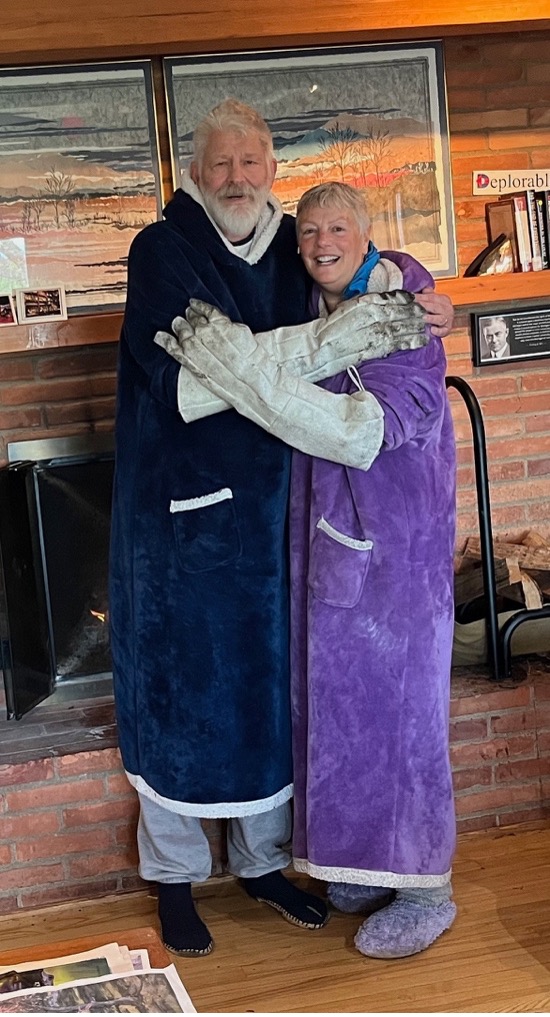
If this story has you hankerin’ for some ribs, here’s the recipe. The Pit-Barrel Cooker people put out a nice video (2). Beer ribs are fun, too (3).

References
1. The Pit Barrel Cooker Co. https://pitbarrelcooker.com
2. Award Winning Pork Ribs by Pit Barrel Cooker Co. https://pitbarrelcooker.com/blogs/food/award-winning-pork-ribs-1
3. Beef Dino Ribs. https://pitbarrelcooker.com/blogs/food/beef-ribs-1

 Bob Ike's blog